
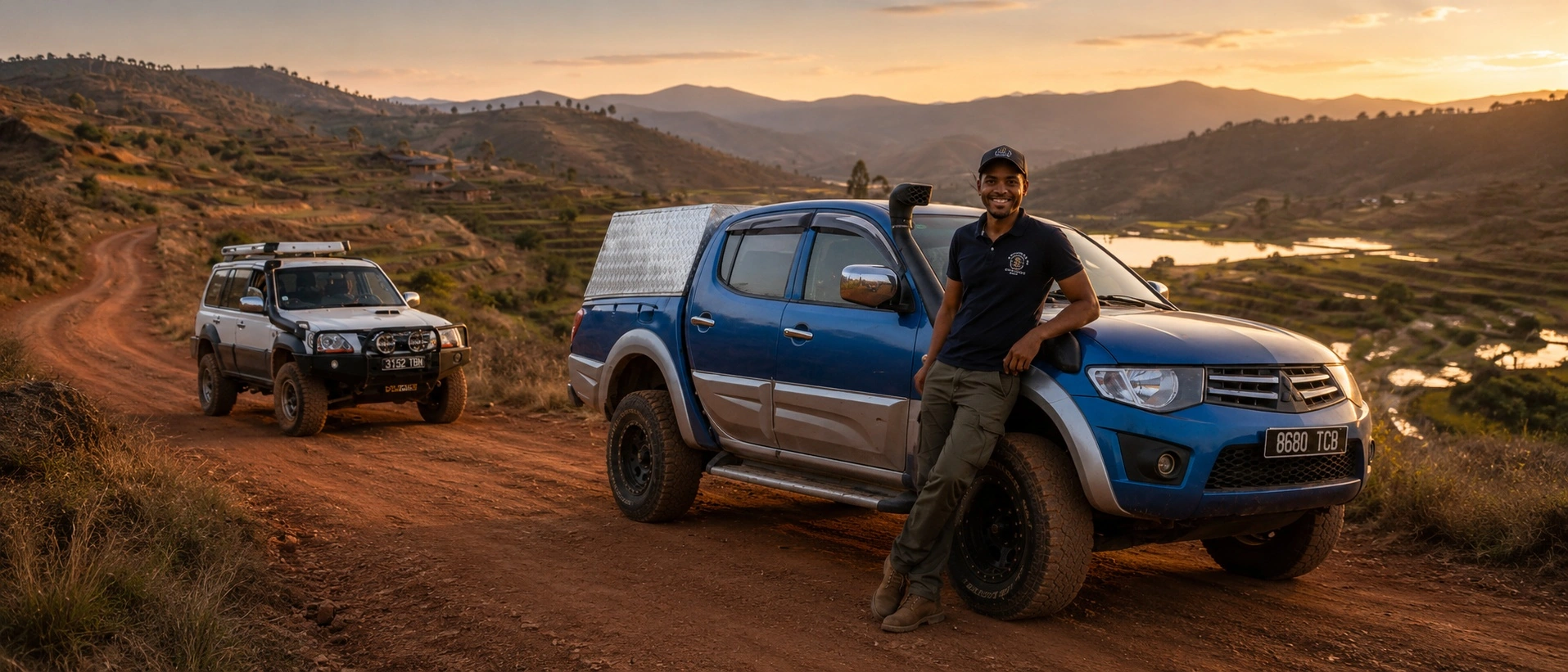
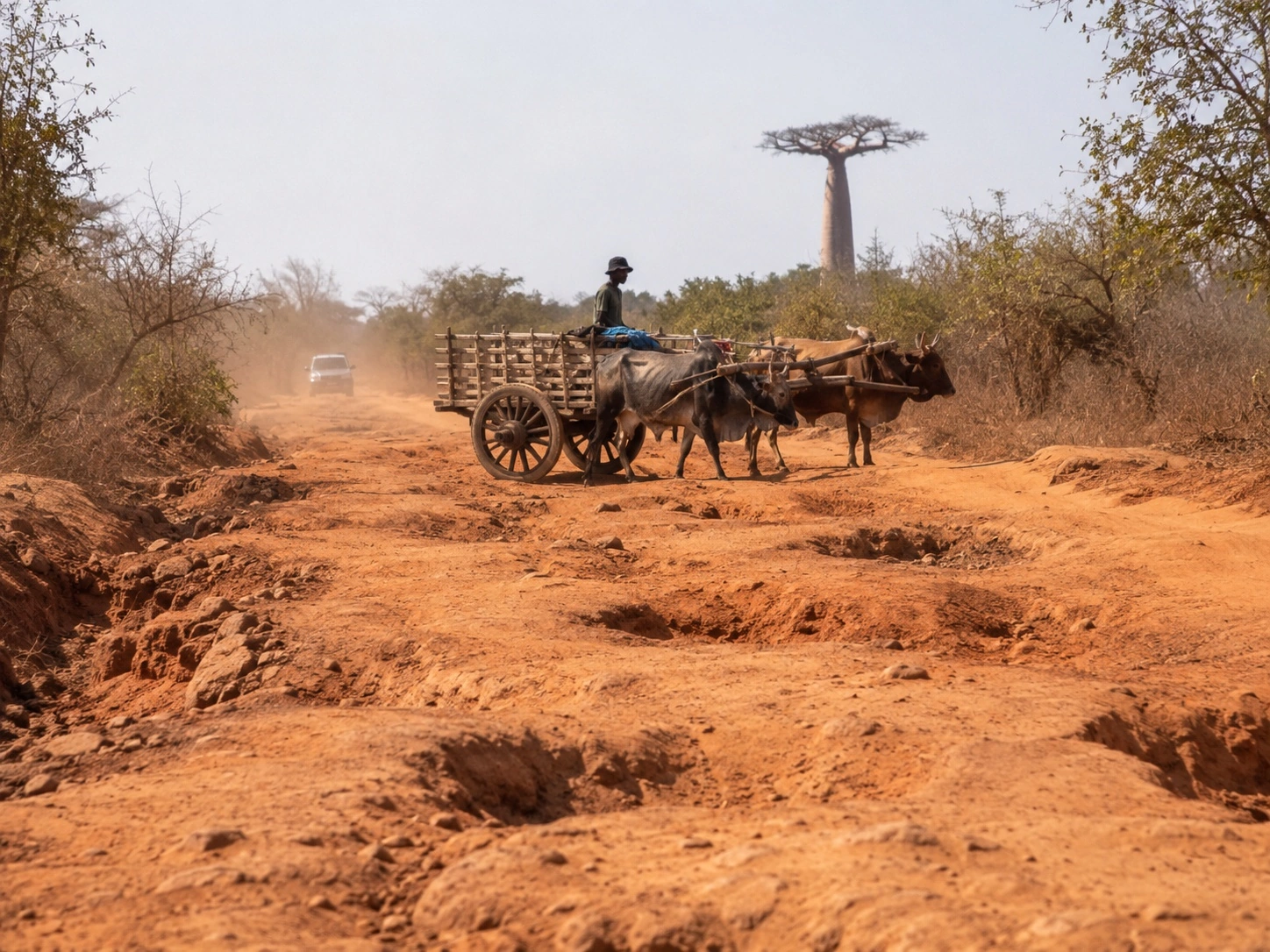
Imagine day three of your trip. A red dirt track full of potholes lies ahead, an ox cart blocks half the road, the navigation stopped making sense two hours ago and the next sign, if there is one, is in Malagasy.
The question is rarely whether self-driving is legally possible. It is. The better question is whether it is how you want to spend your trip. We rent deliberately with a driver only, but this article is not a sales pitch. It is an honest comparison of what speaks for driving yourself, what speaks against it and who each option really suits.
Short answer
For most travellers, Madagascar with a driver is not only more relaxed, but the more realistic and safer choice. Self-driving only suits very experienced off-road travellers with plenty of time and tolerance for setbacks.
The short answer first
First-time visitors almost always underestimate Madagascar's roads. On a map, 180 kilometres can look like half a day. In reality, it can take eight hours depending on weather, ferries, bridges, roadworks or the condition of the track.
That is why an experienced driver-guide is not a luxury here. It is often the difference between stress and a trip that feels good.
Why self-driving in Madagascar is different
Madagascar is often compared with classic road-trip countries. That comparison only goes so far. Main roads are not always reliable, side tracks can change after rain and signage is limited.
There are also language barriers, local routines, police checkpoints, ferries, markets on the road and stages that should not be driven after dark. If you drive yourself, you solve all of that while trying to enjoy your holiday.
The key mistake is treating Madagascar like a simple loop on a map. Many national roads radiate from Antananarivo, while cross-connections can be slow, seasonal or hard to predict. A route that looks logical on Google Maps can turn into long returns, ferry waits or completely different daily stages.
What really speaks for a driver
Safety: tracks, night driving and breakdowns
A driver knows the critical points: where to slow down, when a bridge should be crossed carefully, when rain changes a track and when it is smarter to stop earlier. In case of a breakdown, he knows who to call and what is realistic.
This matters especially for families, travellers with little off-road experience and first-time visitors to Africa. Our page about insurance and emergencies explains how we handle breakdowns, replacement vehicles and availability.
The guide effect: understanding people and place
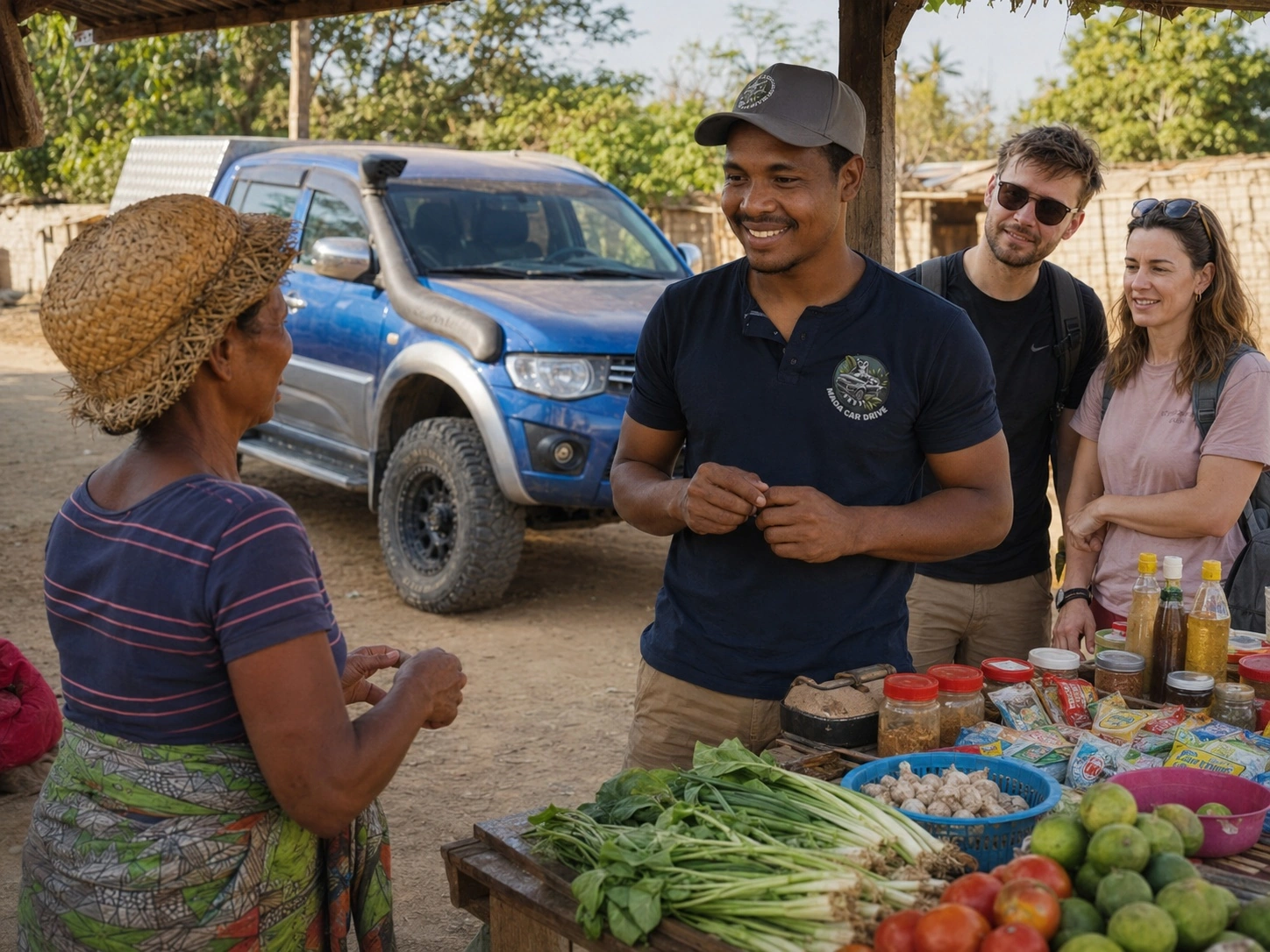
A good driver is more than a driver. He knows useful stops, explains customs, translates daily situations and makes encounters easier at markets, ferries and small accommodations.
This is the difference between passing through and actually arriving. Your driver knows when a market stop is worth it, how long a ferry may really take, when to leave early and where a short break saves the day. A rental car alone cannot provide that local judgement.
Saving time and energy on rough roads
If you are not behind the wheel, you can look out, take photos, rest, plan or simply arrive. On long stages this becomes one of the biggest comfort gains.
Be honest about the effort: eight concentrated hours over potholes, heat, oncoming traffic, people, animals and unclear tracks. Once, that feels like adventure. Every other day for two or three weeks, it becomes work. With a driver, the same stages become part of the journey again.
What speaks for self-driving — and who it suits
Self-driving has an appeal. You feel independent and decide every minute yourself. For very experienced Africa and off-road drivers, it can work if there is enough time, basic French and technical confidence.
For most travellers, that freedom is more theoretical than expected. Once a road is blocked, accommodation is hard to find or a ferry runs differently, freedom quickly becomes work.
Realistically, self-driving is most suitable if these points really apply to you:
- you have experience on African or demanding off-road routes,
- you speak at least basic French,
- you have enough time and stay calm when a daily plan changes,
- you are ready to carry navigation, breakdown risk and driving stress yourself.
If you hesitate on any of these points, a driver is not just the comfortable option, but the smarter one. For families, older travellers and first-time visitors to Africa, we clearly recommend travelling with a driver.
The cost comparison, honestly
At first glance, self-driving may look cheaper. In practice, the difference is smaller. With the driver model, the driver's service and accommodation are included in the daily rate. Fuel is paid separately by consumption.
Self-driving can add higher deposits, insurance surcharges, more damage risk, wrong turns, delays and stress. If you only have 14 to 21 days in the country, lost travel time can cost more than the driver.
At Mada Car Drive, the daily rate is €50 in Antananarivo and €65 outside Antananarivo, including the driver and the driver's accommodation. Fuel is billed separately by actual consumption, so it stays clear what the vehicle and driver cost and what is really used on the road.
How it works with Mada Car Drive
Send us your dates, group size and desired route. We check whether the stages are realistic, which vehicle fits and how much time you should plan. You get a clear assessment before you decide.
Then you confirm the trip with a 10% deposit. Handover is in Antananarivo. Personal support is handled by Kevin in German and English; on the road you travel with a Malagasy driver-guide. A free enquiry is the easiest starting point.
Frequently asked questions
Legally, self-driving is possible, but it is uncommon and difficult to organise. Most independent travellers use a driver because road conditions, limited signage and language barriers make driving yourself demanding. Mada Car Drive deliberately rents only with an experienced driver-guide.